

Amanda Pascali
February 27, 2027 @ 7:30 pm - 9:30 pm
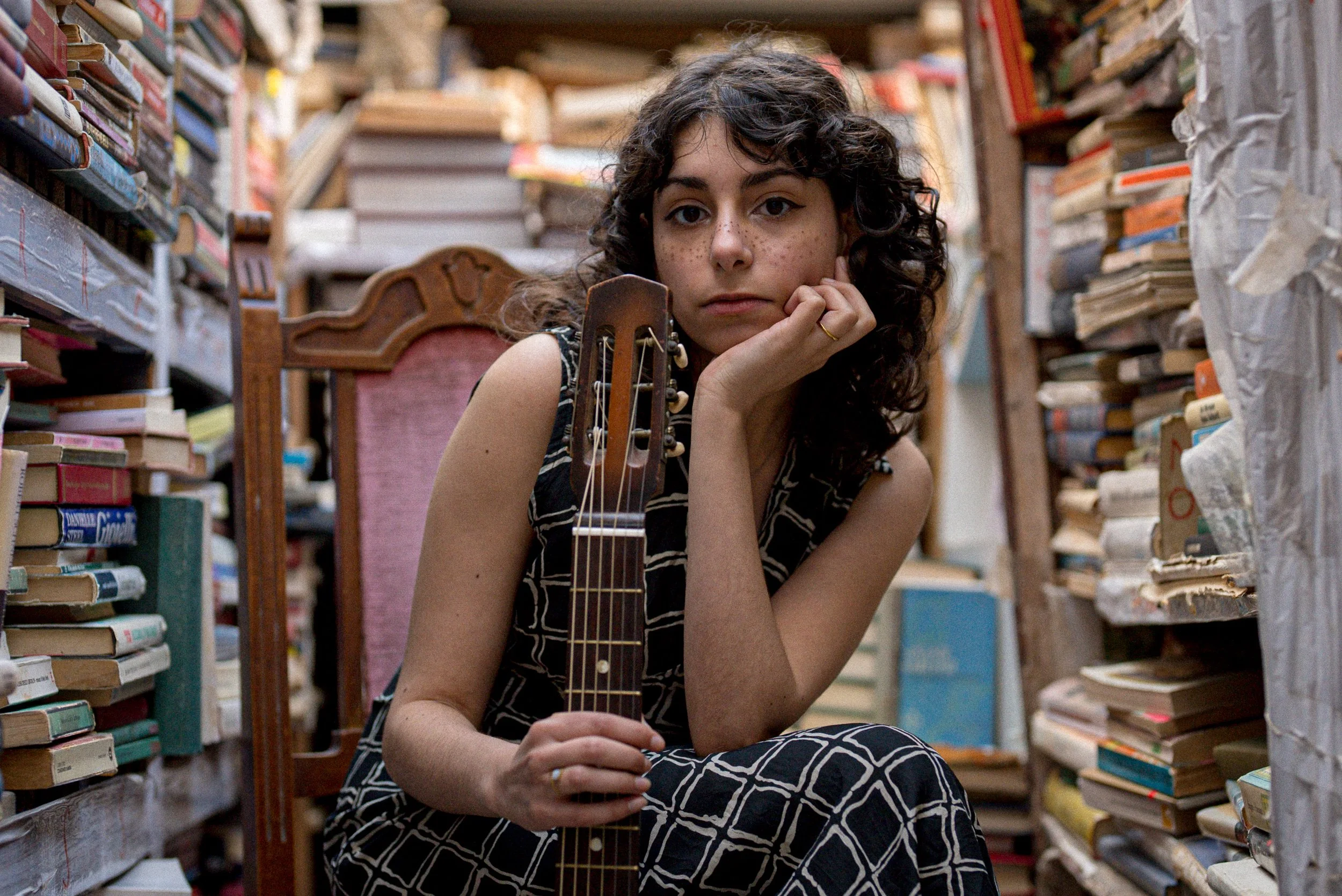
Amanda Pascali embodies the complexity of modern identity. Born to a mother from Cairo who grew up in France and an Italian father raised in Romania, she’s a mixed-race, bilingual Gen Z troubadour perpetually caught between worlds. Quoting poet Ijeoma Umebinyuo, she says, “I’m often ‘too foreign for here, too foreign for home, and never enough for both.’” Rather than lamenting this displacement, Pascali has transformed it into her artistic superpower. In her bright red teenage bedroom, she started writing songs about her life and family, later singing them at coffeehouses and motorcycle bars. Her curiosity eventually led her to Palermo on a Fulbright fellowship, where she spent two years developing To Sing and Recount (Canta e Cunta) — a digital storytelling project that translates and revitalizes Southern Italian folk songs, revealing their startling relevance to contemporary social issues worldwide.
At fourteen, surfing the internet, Pascali happened upon Sicilian folk legend Rosa Balistreri’s music and was immediately struck by her rebelliousness. “She was more punk than any of the bands whose posters hung on my wall,” Pascali recounts. “Rosa defied all the norms of her time. She endured famine and poverty: learning to read at thirty-two, picking up a guitar at forty, then turning both into tools of resistance.” Pascali began translating these canzoni d’autore and traditional songs into English, marveling at the vivid characters populating her songs. They reminded her of Bob Dylan’s protagonists, but wilder, rawer — a thousand times more revolutionary. Her new album, Roses and Basil, reimagines these and other folk song translations alongside her own immigrant-American folk songs.
“Wake Up, Baby,” the lead single from Roses and Basil, exemplifies this timetraveling approach. Starting with one of Sicily’s oldest serenatas — the story of a man singing his marriage proposal to a lover’s balcony while she sleeps through it — Pascali flips the narrative entirely. In her version, the woman isn’t sleeping; she’s ignoring him. “It connects the experience of waiting beneath a window to the modern frustration of being, as my generation would say, ‘left on read,’” she explains. The song moves like a brisk tango shifting from minor verse melancholy to major chorus hope, with more than a few nods to Roy Orbison’s “In Dreams.”
Pascali’s work songs, protest numbers, lullabies and ballads about everyday struggle are resonating with a diverse global audience. With one viral video after another, she has garnered over 130k followers on Instagram. Her fans appreciate her captivating voice, poeticism and preternatural ability to find old songs that reverberate across countries and centuries. The accolades have followed: Fulbright Scholar, Artist-in-Residence at the Library of Congress, World Expo performer in Osaka, official showcase artist at Folk Alliance International, and awards from the Calandra Institute, Mid-America Arts Alliance, Kerrville Folk Festival, and Houston Arts Alliance. But perhaps more meaningfully, Pascali proves that old songs can be endlessly reshaped for new generations.
Amanda Pascali –
As the rising voice of America’s most ethnically diverse generation of young people, 26-year-old Amanda Pascali writes songs that speak to the experience of growing up as a first-generation American. In 2023 her popularity exploded on social media following several viral videos of her song translations. Amanda’s music, now coined, Immigrant American Folk delivers a powerful narrative on being, “too foreign for here, too foreign for home, and never enough for both.”
The internationally acclaimed, bilingual singer/songwriter and 2021 Houston Chronicle “Musician of the Year,” was born in Queens, New York, and is based between Houston, Texas and Palermo, Sicily. Amanda has released music and performed internationally, from the John F. Kennedy Center in Washington D.C. to the European Union Parliament in Brussels and across the globe. Her latest work, To Sing and Recount, is a project to translate and revitalize the Sicilian folk songs endorsed by the US State Department and the Italian Ministry of Foreign Affairs.
Blending folk/Americana influences with southern Italian and Latin rhythms Pascali’s songs are powerful tales of America told through the eyes of immigrants and those who have always felt like the “other”. With a father who was thrown out of his home country for rebelling against the government and an immigrant mother who built a career from scratch in 1980s Brooklyn, Amanda was driven from a young age to be a messenger of her family’s stories and diaspora